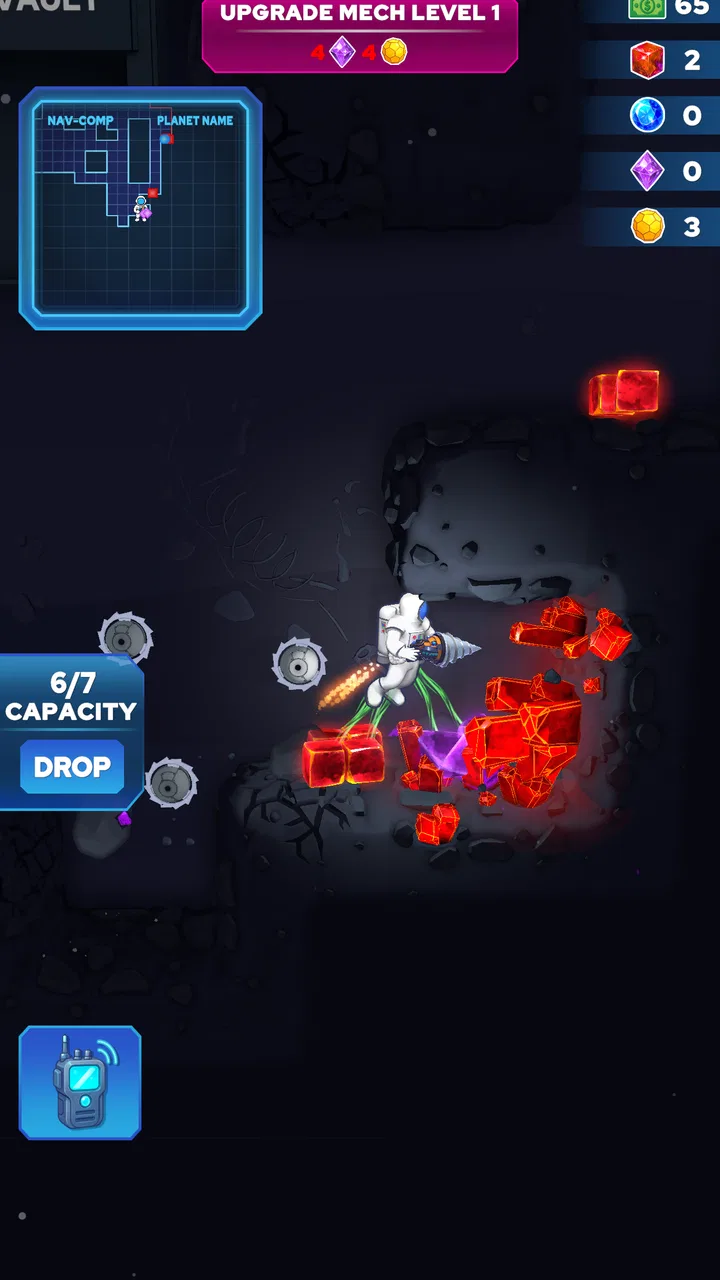
Bedrock Miner
- 3.1
- Rating
- 10.00K
- Installs
- Free
- Price

 Analysis by App-foxy
I found Bedrock Miner most enjoyable as a small, low-pressure arcade game for short sessions rather than a main event. Its basic appeal is easy to understand: mine, improve your engineer, and keep exploring for surprises below the surface. That simple loop makes it a natural fit for a shared phone or tablet in a household where different people want something they can pick up without a long explanation.
My experience was more mixed once I looked beyond the first few sessions. The game has a relaxing idea at its center, but the enjoyment depends heavily on whether you like gradual progress and repeated actions. It is free to start, suitable for Everyone, and made by AleksandrFoman, yet its modest average of 3.1 from roughly 140 ratings suggests that the experience will not satisfy every arcade player. I can see why some people would enjoy its calm rhythm, while others may find it too limited or too slow.
How Bedrock Miner Works in Everyday Use
I find Bedrock Miner easiest to judge by the small decisions it invites: what to do first, when to improve the engineer, and when to stop for now. In this section, I’ll focus on how that rhythm fits into an ordinary day, including the practical choices that make a shared or solo session feel less aimless. That gives us a useful starting point for looking more closely at the game’s moment-to-moment feedback.
You May Also Like

 Blood Strike: 2.5 Anniversary
Blood Strike’s Loadouts Turn Every Drop Into a Tactical Gamble
A close look at Blood Strike’s custom loadouts: how fast access to signature weapons reshapes its battle royale rhythm, rewards preparation, and narrows the gap between fights.

 Pandora - Music & Podcasts
Pandora’s Music Is Easy to Start, but Harder to Recover
Pandora’s strength is its low-effort path from a seed to a station. Its weak spot is how much confidence it asks you to place in connection, setup, and quiet recovery.

 8 Ball Pool
 Is Built on Rivalries, Rematches, and Routine
A close look at the rivalries, rematches, shared routines, and unanswered safety questions that turn a quick pool match into a persistent mobile community.

 Samsung Music
’s Quiet Strength Is Playing What You Already Own
Its reach comes less from spectacle than from dependable access to a personal library. That simplicity is both the app’s strongest retention engine and its ceiling.

 AccuWeather: Weather Radar
AccuWeather Review: A Quick, Clear Forecast for Everyday Decisions
For everyday plans, the best forecast is the one you can understand quickly. AccuWeather makes rain timing, radar, and local conditions easy to act on, with a few trade-offs.

 Hill Climb Racing
Why Hill Climb Racing Still Turns Crashes Into One More Run
A tiny car, a bumpy hill and one more upgrade: Hill Climb Racing keeps resurfacing because its simple chaos makes every near-miss feel personal.
More From Our News Desk
View All News


A practical shared-device game
Bedrock Miner works well in a situation I know many households have: one person finishes using a tablet, another wants a quick game, and nobody wants to hand over a complicated account or explain a long story. Because the main idea is immediately readable, a family member can understand the objective after watching for a moment. One player can dig for a while, stop, and let someone else continue without the whole evening depending on a single uninterrupted session.
I would especially consider it for a quiet break after school, a short wait, or a few minutes before bed. The mining theme gives the player a clear reason to continue, while the upgrade element supplies a sense of progress. It is less demanding than an arcade game built around rapid reactions, so it can suit someone who prefers tapping and planning over constant precision.
That does not mean every shared-device arrangement will feel seamless. Progress in a mining game is personal by nature. If several people use the same device, they need to agree whether they are sharing one run or taking turns with the same progress. I would not assume that the game separates household players automatically. Before handing it around, I would decide on a simple rule: one shared save for everyone, or one main player who owns the upgrades.
That small conversation matters more than it sounds. A younger player may spend resources on an upgrade that an older player was saving for, while another person may explore in a direction that changes the pace of the run. The game can become a pleasant cooperative routine if expectations are clear, but it can also create unnecessary arguments if everybody treats the same progress as private.
Starting without turning setup into a project
The entry point is straightforward. Bedrock Miner is free, and it runs on Android versions from 7.0 onward, so it is not restricted to only recent phones and tablets. The current release is 1.0.9.2, which makes it sensible to check that the device is updated before judging the experience, particularly if an older shared device behaves differently from a newer one.
I would install it first on the household device and play through the opening portion alone. That gives the main user a chance to understand the rhythm before children or other family members join in. It also prevents the first shared session from becoming a tutorial meeting where nobody knows which choices are important.
There is one boundary I would set immediately: purchases. The game is free, but its optional in-app items range from $0.99 to $99.99 each. That is a wide range, and it is the most important household detail to discuss before anyone else plays. I would not leave a shared device unlocked for purchases. Instead, I would require the device owner to approve anything paid, or simply agree that the game will be used without spending.
This is not just an issue for children. Adults can also tap through a purchase quickly when they are focused on progress. A clear household rule avoids confusion later: free play is available, but paid items require permission every time. If you are looking for a game that can be placed on a family device with no purchase conversation at all, this is not the easiest choice.
Keeping progress understandable between players
The most useful coordination method I found is to treat each session as a small handoff. The person stopping can say what they were working toward, which upgrade they considered, and whether they were exploring or concentrating on improving the engineer. That keeps the next player from making a decision without context.
For a shared tablet, I would even keep a short note beside the device if the household is using one common run. Something as simple as “saving for the next upgrade” or “explore first” can prevent the familiar problem where one player spends everything because the goal was never stated. This is a practical advantage of the game’s uncomplicated structure: coordination does not require a spreadsheet or a complicated strategy guide.
There is also a trade-off here. A shared run can make the mining feel social, but it reduces individual control. If one person enjoys experimenting and another wants efficient progress, their preferred styles may clash. Bedrock Miner is better for households that can laugh off an imperfect decision than for players who want every upgrade choice optimized.
For solo use, I would make the opposite recommendation: choose a personal routine and stick with it. Rather than changing direction every few minutes, I found it more satisfying to decide whether a session was about improving the engineer or uncovering more of the underground area. That simple focus makes the repeated actions feel more purposeful.
Age suitability and trust
The Everyone content rating makes the game approachable for a broad age range. In practical terms, I see it fitting a child who likes digging, collecting, and gradual improvement, as well as an adult who wants a gentle arcade distraction. The absence of a demanding story also helps when different ages are sharing the same screen; nobody needs to understand a large fictional world before playing.
Still, an age rating is not the same as a complete household recommendation. Younger players may need help understanding the difference between ordinary in-game progress and a paid item. I would explain that the game can be played for free, but a button connected to real money is a separate decision. That conversation is especially important because the purchase range reaches as high as $99.99 per item.
I would also use the first session to see how a child responds to the game’s repetition. Some children enjoy the predictable cycle of mining and upgrading, while others quickly want faster action or more variety. Bedrock Miner feels more suitable for a patient player than for someone expecting a constant stream of new challenges.
For adults sharing with children, trust works best when it is visible rather than assumed. I would play beside the child at least once, show which choices are safe to make freely, and establish who decides about spending. That approach is more realistic than treating the Everyone label as a substitute for supervision.
What makes the loop relaxing, and where it slows down
The game’s strongest quality is its approachable loop. Mining gives the player an immediate task, upgrades provide a reason to continue, and the possibility of finding something unexpected adds curiosity. I like that this combination does not demand a long uninterrupted commitment. It is easy to imagine playing for a few minutes, putting the device down, and returning later.
The weakness is the same loop viewed from another angle. Repeated mining can lose its charm if the player needs more mechanical variety, faster movement, or deeper strategic decisions. The store summary emphasizes relaxation, and I think that is the right way to approach it. If you expect an intense arcade challenge, the calm design may feel underpowered rather than relaxing.
My practical tip is to use the game as a reset between demanding tasks, not as a reward that must occupy an entire afternoon. Short sessions protect the pleasant part of the experience. When I stayed with the same actions for too long, the sense of discovery became less noticeable and the upgrade goal started to feel like routine.
Another useful approach is to alternate objectives. One session can focus on improving the engineer, while the next can prioritize exploration. This prevents the game from becoming a single repetitive chore and gives a shared household run a natural way to divide responsibilities. One player can enjoy optimization while another gets the excitement of looking for secrets.
How it compares with familiar arcade alternatives
Compared with reflex-focused arcade games, Bedrock Miner is more forgiving and more progression-oriented. You are not choosing it for instant rounds built around avoiding obstacles or chasing a high score. Its appeal is the gradual feeling that the engineer is becoming more capable and that continued exploration may reveal something worthwhile.
Compared with large mining or crafting games, it is easier to approach but less likely to satisfy someone who wants an expansive world, extensive construction, or a deep inventory system. I would choose this game when I want a compact mining theme without committing to a large project. I would choose a bigger alternative when I want detailed planning, creative building, or a world that can occupy many different play styles.
It also differs from purely idle games. Bedrock Miner invites the player to remain involved in the mining process rather than simply checking a timer and collecting rewards. That makes it a better fit for someone who wants light interaction, although players seeking completely hands-off progress may prefer an idle format.
The rating of 3.1, based on around 140 ratings and 35 reviews, is worth keeping in perspective. It is not a reason to dismiss the game, but it does reinforce my impression that the design has a narrower audience than the simple premise might suggest. People who enjoy calm incremental arcade play may find it appealing; people looking for polished depth or constant novelty should be more cautious.
Who should install it, and who should skip it
I would recommend Bedrock Miner to someone who likes gentle arcade games, visible upgrades, and the satisfaction of uncovering things gradually. It is also a reasonable choice for a shared household device when players can agree on how to handle one progress path and when an adult sets clear purchase boundaries.
I would be more selective for children who become frustrated by slow progress or who tend to tap through purchase prompts without asking. The Everyone rating makes the content broadly accessible, but household supervision still matters because the game includes paid items. I would also skip it for a player who wants competitive leaderboards, complex multiplayer coordination, or a high-pressure challenge; nothing about its core appeal points in that direction.
For an older phone or tablet, the minimum Android requirement is reassuring, but I would still test the game personally before making it the main shared entertainment option. A short trial reveals more than the category label: you can see whether the controls feel comfortable, whether the pace suits the intended player, and whether the household can share progress without friction.
My household verdict
Bedrock Miner is a modest, approachable arcade game with a clear place in a household library. I like its mining-and-upgrade structure when I want something calm, and I can see it working well as a pass-around game on a shared device. The strongest use case is not a marathon session; it is a handful of focused visits where each player knows what they are trying to do.
The main caution is the gap between “free” and genuinely worry-free on a shared device. Since in-app purchases run from $0.99 to $99.99 per item, I would set spending boundaries before anyone else plays. I would also agree on whether progress belongs to one person or to the household. Those two decisions will shape the experience more than the mining theme itself.
After considering the pace, the broad age rating, and the relatively modest reception, my opinion is positive but limited. Bedrock Miner is best treated as a quiet, turn-based household distraction, not a complete arcade centerpiece. If that description matches what you want, the free entry point makes it easy to try. If your household needs separate player identities, deep strategy, or nonstop action, a different arcade or mining game will probably be a better fit.
For me, the final decision comes down to expectations. I would install it on a shared device for relaxed exploration, explain the purchase rule, and let each player take short turns. Used that way, it has a pleasant simplicity. Asked to provide endless variety or a demanding long-term challenge, it would fall short.
FAQs for Bedrock Miner
01What is Bedrock Miner, and what do you do in the game?
Bedrock Miner is a mining-focused game built around digging through underground layers, collecting valuable resources, upgrading equipment, and progressing through increasingly challenging areas. During play, you typically manage your mining tools, decide which materials are worth pursuing, and use the rewards to improve your character or equipment. The main appeal is its simple progression loop, although the exact objectives and available features may vary between versions.
02Is Bedrock Miner free to download and play?
Bedrock Miner can generally be downloaded without an upfront purchase, but players should check the store listing for the current pricing and monetization details before installing it. Like many mobile games, it may include optional advertisements, in-app purchases, or upgrade-related offers. You can usually begin playing for free, but some features, resources, or faster progression may require watching ads or spending real money.
03Does Bedrock Miner require an internet connection?
Whether Bedrock Miner works fully offline depends on the version installed and the feature you are using. Core mining gameplay may be available without a constant connection, but advertisements, cloud saves, updates, leaderboards, or in-app purchases may require internet access. If offline play is important to you, test the game after installation with mobile data and Wi-Fi disabled, and review the developer’s latest store information.
04Is Bedrock Miner suitable for children?
Bedrock Miner is generally easy to understand because its gameplay focuses on mining, collecting resources, and upgrading equipment. However, parents should review the age rating, advertising behavior, chat or social features, and available in-app purchases before allowing younger children to play. If purchases are enabled on the device, parental controls are recommended, since optional offers can appear during progression depending on the version.
05What devices are compatible with Bedrock Miner?
Compatibility depends on the operating system, device model, available storage, and the minimum software version required by the current release. Before downloading Bedrock Miner, check its official Google Play or App Store page for supported Android or iOS versions. Older phones may install the game but provide slower loading, reduced visual quality, or occasional performance issues, especially when storage or memory is limited.
Pros
- Simple controls make mining easy to learn on mobile.
- Randomly generated worlds offer fresh exploration each time.
- Crafting encourages creative building and resource management.
- Offline play is convenient when you have no internet access.
- Lightweight gameplay runs well on many older devices.
Cons
- Graphics may feel basic compared with modern sandbox games.
- Progress can become repetitive after extended mining sessions.
- Limited enemy variety reduces the challenge for experienced players.
- Touch controls can feel imprecise during combat or platforming.
- Ads or optional purchases may interrupt the free experience.

Bedrock Miner
Gallery